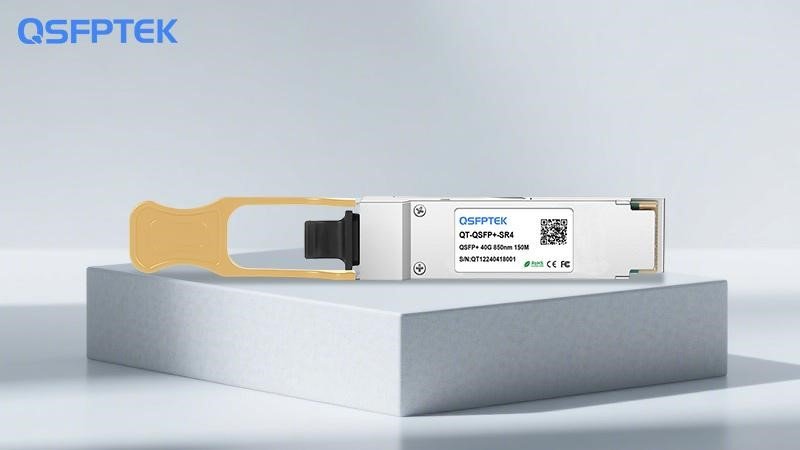
The Application of 40G SR4 Modules in Enterprise Campus Networks
When discussing 40G optical modules, most professionals immediately think of large-scale data centers where ultra-high bandwidth and high-density interconnects are essential. However, 40G SR4 (Short Range 4-lane) modules are not limited to massive cloud or hyperscale environments. They also play a significant role in enterprise campus networks, particularly when it comes to connecting core switches, aggregation layers, and critical applications that require reliable high-speed communication.
What is 40G SR4
40G SR4 modules are multimode optical transceivers designed to transmit and receive four parallel lanes of 10G data over a ribbon fiber with MPO/MTP connectors. They typically support OM3 fiber up to 100 meters and OM4 fiber up to 150 meters. With this short-reach capability, they are not intended for long-haul applications but are ideal for high-bandwidth connections inside campuses or between nearby buildings.
Why Enterprise Campus Networks Need 40G
Enterprise campus networks have evolved significantly over the past decade. Applications such as real-time collaboration, cloud-based services, unified communications, and video conferencing have increased the demand for greater bandwidth and faster response times. Core switches within campus networks must handle high volumes of data while ensuring seamless connectivity across departments, office buildings, and even research facilities.
In this context, 40G SR4 transceivers offer a practical solution. They deliver the performance required for enterprise-scale networking without the cost and complexity associated with long-distance optical modules like LR4 or ER4.
Application in Campus Networks
Core-to-Core Switch Interconnection
In many campus networks, multiple core switches are deployed for redundancy and load balancing. 40G SR4 modules provide a cost-effective way to interconnect these switches with high throughput and minimal latency.
Core to Aggregation Layer Connections
Enterprises with multiple departments often rely on an aggregation layer to consolidate traffic before reaching the core. Deploying 40G SR4 between core and aggregation switches ensures smooth handling of data-heavy applications such as video streaming, virtual desktop infrastructure (VDI), and enterprise resource planning (ERP) systems.
Inter-Building Connectivity in Campus Environments
For large universities, hospitals, or corporate campuses with multiple buildings, 40G SR4 can be used to connect networking equipment within a short geographical range. Its short-reach design is well-suited for such deployments where distances are typically under 150 meters.
Support for High-Performance Applications
Emerging enterprise needs, such as AI-assisted analytics, edge computing workloads, and centralized storage, demand higher bandwidth within the campus backbone. SR4 modules ensure that networks are ready to accommodate these workloads without bottlenecks.
Benefits of 40G SR4 in Enterprise Networks
Cost Efficiency: Compared with long-range modules, SR4 is more affordable and requires fewer complex optical components.
High Density: The use of MPO/MTP connectors allows for streamlined cabling in high-density switch environments.
Scalability: Enterprises can gradually scale from 10G to 40G while leveraging existing multimode fiber infrastructure.
Low Latency: The parallel transmission design supports fast and efficient data delivery.
Conclusion
40G SR4 modules may have gained popularity in data centers, but their advantages extend well into enterprise campus networks. By enabling high-speed, short-distance connections between core switches, aggregation layers, and inter-building links, they help organizations achieve reliable, scalable, and cost-effective network performance. For enterprises seeking to future-proof their campus backbone while controlling costs, 40G SR4 remains a practical and forward-looking choice.






Post Comment