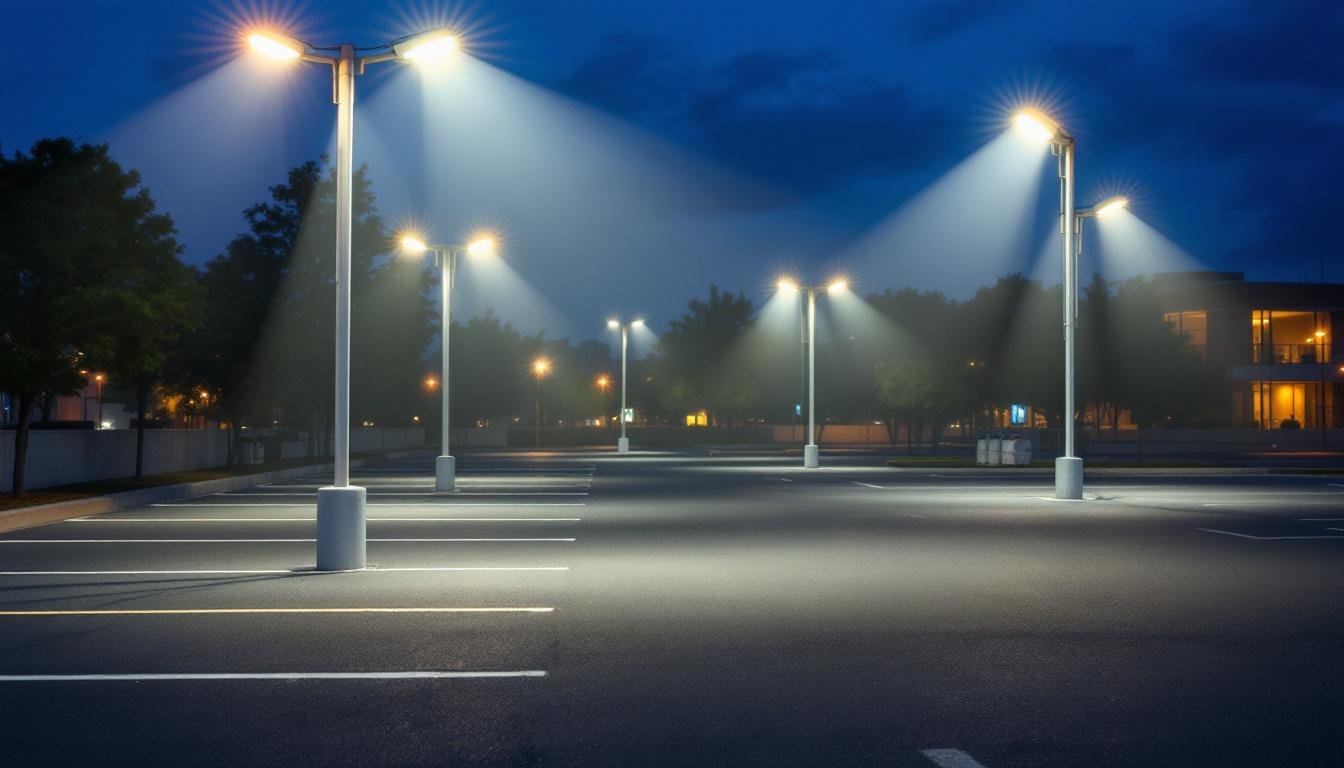
Parking Lot Lights: Complete Guide to Choosing the Right Solution
Parking lot lights keep your property safe and bright at night. They help customers feel secure. They stop crime. They make accidents less likely. Good lighting also shows your business cares about safety.
Many property owners still use old lighting types. These cost too much money. They use too much power. They break down often. New LED parking lot lights work better. They save money. They last longer. They use less electricity.
This guide explains what parking lot lights are. It shows you the best options. It helps you pick the right type for your needs.
Why Good Parking Lot Lights Matter
Your parking area needs proper lighting. Bad lighting causes problems. People cannot see well. Thieves target dark areas. Car accidents happen more often. Customers feel unsafe.
Good parking lot lights solve these issues. They make people feel safe. They reduce theft and vandalism. They help prevent accidents. Police like well-lit areas. Insurance companies give lower rates for well-lit parking lots.
Light cuts crime by up to 40%. Accidents drop when lighting improves. Customer satisfaction goes up. Your business looks more professional.
Why parking lot lights are essential:
- Customers trust well-lit spaces more
- Police notice and patrol lit areas
- Theft and break-ins decrease significantly
- Accidents and injuries happen less often
- Your insurance costs go down
- Staff feel safer during night shifts
- You follow local safety laws
- Vehicle damage claims decrease
Types of Parking Lot Lights
Different parking lot lights work in different ways. Some are old technology. Some are new. Each type has pros and cons.
Old-Style HID Lights
HID lights use metal halide or sodium vapor bulbs. Many parking lots still use these. They produce bright light. But they have real problems.
HID lights need time to turn on. They take 10-15 minutes to reach full brightness. They waste massive amounts of electricity. A typical HID fixture uses 150-400 watts. They break often. A bulb lasts about 12,000 hours. That means replacing bulbs every 2-3 years. Heat output is extreme. They create dark spots and bright spots. Light quality is poor.
Problems with HID parking lot lights:
- Uses 2-3 times more power than LED
- Bulbs burn out frequently
- Takes 15 minutes to warm up
- Replacement costs add up fast
- Creates uneven light patches
- Generates excessive heat
- Cannot be dimmed easily
Modern LED Parking Lot Lights
LED lights are the new standard. They work differently than HID lights. They turn on instantly. They use far less electricity.
LED parking lot lights use only 100-150 watts to match HID brightness. They reach full power immediately. No warm-up time. One LED bulb lasts 50,000+ hours. That is 5-10 years of continuous use. They produce better quality light. They cost less to maintain. They save thousands in electricity bills.
Modern LED fixtures include smart features. Photocells turn lights on and off. Dimmers reduce power during slow hours. Color options let you choose warm or bright light.
Why LED parking lot lights win:
- Uses 40-60% less electricity than HID
- Turns on instantly without delay
- Lasts 50,000+ hours (5-10 years)
- Produces even, consistent light
- Requires minimal maintenance
- Lower replacement costs
- Can be dimmed for energy savings
- Better light quality and visibility
- Includes smart control options
- Better for the environment
How Much Parking Lot Lights Save You
The cost savings from LED lights are real and measurable. Let’s look at actual numbers.
A typical shopping center has 100 parking lot lights. They run 12 hours per day. Old HID lights use 400 watts each. That is 40,000 watts total per day. Over a year, that costs around $35,000 in electricity.
The same parking lot with LED lights uses only 150 watts per fixture. That is 15,000 watts total. The yearly electricity bill drops to $13,000. You save $22,000 per year. Over 5 years, that is $110,000 saved on just electricity.
Add maintenance savings. HID bulbs fail often. Replacement costs $200-500 per bulb per year. LED bulbs rarely fail. Annual maintenance drops from $10,000 to $1,000. That saves another $45,000 over 5 years.
Total five-year savings: $155,000 on a 100-light system.
Real savings breakdown:
- Electricity savings: $22,000 per year
- Bulb replacement savings: $9,000 per year
- Maintenance labor savings: $2,000 per year
- Total annual savings: $33,000 per year
- Five-year savings: $155,000+
Key Features to Look for in Parking Lot Lights
Not all parking lot lights are the same. Important features affect performance and cost.
Brightness (Lumens)
Lumens measure how bright the light is. More lumens mean more light output. A 150-watt LED produces about 20,000-22,000 lumens. This covers a standard parking space area well.
Choose lumens based on your space size and type. Small lots need less. Large facilities need more. Ask a lighting expert for your specific area.
Light Color
Light color matters for safety and appearance. Color is measured in Kelvin (K).
Warm white (3000K) is soft and welcoming. It is good for retail areas. Cool white (5000K) is bright and clear. It is better for security and safety. Most parking lots use 5000K.
Photocells
A photocell is a sensor that detects sunlight. When the sun sets, the photocell turns lights on. When the sun rises, it turns them off. This automatic feature saves energy. You do not need to manually control anything.
Dimming Controls
Smart dimming reduces power during off-peak hours. Late night traffic is light. Lights can reduce to 50% brightness. You still see well. But you save 50% electricity during those hours.
Mounting Options
Different parking lot lights mount in different ways. Slip-fit mounts go on existing poles. Arm mounts attach to poles with brackets. Post-top mounts sit on top of poles. Choose based on your pole type and preference.
Important parking lot lights features:
- Brightness (15,000-45,000 lumens typical range)
- Color temperature (3000K warm or 5000K cool)
- Photocell for automatic on/off
- Dimming capability to reduce night usage
- Quality aluminum or steel housing
- Waterproof seals (IP65 or higher rating)
- Wide beam angle for even coverage
- 5+ year warranty from manufacturer
- DLC or UL certification proving efficiency
- Can handle local temperature extremes
Installation and Setup
Proper installation matters. Poor installation causes problems.
Hire a licensed electrician. They know local codes and safety rules. They install everything correctly. They ensure proper grounding and electrical connections.
Lighting height affects coverage. Most parking lot lights mount 20-40 feet high. Higher lights cover wider areas. They create fewer shadows. Spacing matters too. Lights should be 80-130 feet apart depending on wattage.
Professionals should install photocells correctly. Wrong photocell setup means lights stay on during daytime. This wastes electricity. Proper setup turns lights on at dusk and off at dawn.
Installation best practices:
- Hire licensed electricians only
- Mount lights at 20-40 feet height
- Space lights 80-130 feet apart
- Ensure proper electrical grounding
- Install photocells accurately
- Test systems before final approval
- Follow all local electrical codes
- Document installation details
Legal Requirements and Standards
Local laws require parking lot lighting. Different areas have different rules.
Many cities require minimum light levels. Most need at least 1 foot-candle of light (brightness measurement). Some require 2 foot-candles for safety. Business areas often need higher levels.
Parking lots must meet electrical codes. The National Electrical Code (NEC) sets safety standards. Most cities adopt these codes.
DLC certification means lights meet efficiency standards. This qualification shows the product is proven to work well. Some utilities offer rebates for DLC-certified lights.
Check with your local building department. Ask what your parking lot needs. Ask about incentive programs. Some utilities pay rebates for LED upgrades.
Legal and code requirements:
- Contact local building department
- Ask about minimum light requirements
- Check electrical code standards
- Look for DLC-certified products
- Ask about utility rebate programs
- Get written approval before installation
- Keep permits and documentation
Common Mistakes to Avoid
Many parking lot owners make preventable mistakes.
Do not buy the cheapest option. Cheap lights fail quickly. They use too much power. You waste money in the long run. Spend more upfront for quality products. You save money over 5-10 years.
Do not skip professional installation. DIY installation causes problems. You risk electrical hazards. Your warranty may not cover improper installation. Poor installation voids manufacturer coverage.
Do not ignore maintenance. Even quality lights need cleaning. Dirt and dust reduce brightness. Clean fixtures quarterly. Inspect for damage regularly.
Do not use the wrong color temperature. Cool white (5000K) is better for parking lots than warm white (3000K). Warm light makes visibility worse. Cool light is safer.
Mistakes that cost money:
- Choosing the cheapest lights available
- Using DIY installation instead of professionals
- Skipping regular cleaning and maintenance
- Installing wrong color temperature for your needs
- Ignoring photocell calibration
- Not getting proper permits
- Failing to inspect systems regularly
Making the Right Choice
Picking parking lot lights requires thinking about your specific situation. Every property is different.
Start by measuring your parking area. Count the space. Determine how bright you need things to be. Think about your budget.
Talk to licensed lighting professionals. They assess your space. They recommend proper wattage and quantity. They provide accurate cost estimates.
Get multiple quotes. Compare prices and product quality. Do not just pick the lowest cost. Consider energy savings over time.
Ask about rebates. Many utility companies offer money back for LED upgrades. This reduces your upfront cost. It improves your return on investment.
Calculate payback period. Most LED upgrades pay back in 2-4 years. After that, all savings go to your bottom line.
Decision-making checklist:
- Measure your parking area accurately
- Determine required brightness level
- Get quotes from multiple lighting companies
- Compare total cost of ownership, not just price
- Research available utility rebates
- Calculate payback period
- Check product warranties
- Review DLC or UL certifications
- Plan for long-term maintenance
- Ask about emergency lighting options
Summary
Good parking lot lights improve safety and security. They save money on electricity and maintenance. Modern LED parking lot lights are far better than old HID lights.
LED lights use less power. They last longer. They need less maintenance. They save thousands of dollars. They make customers feel safer.
Invest in quality lights. Hire professional installers. Get proper permits. Maintain your system regularly. Your parking lot will be safer, brighter, and more cost-effective for years to come.




Post Comment